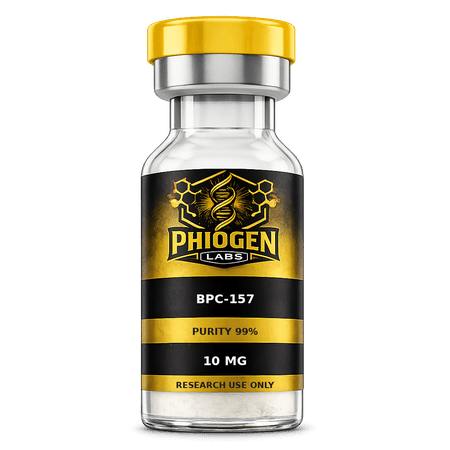
BPC-157 20mg
Ships from USA
1–3 day delivery
Free Shipping
On orders $150+
Peptide Handling & Storage Guide
Storage temperature, shelf life & reconstitution (PDF)
99%+ Purity
COA included
Same-Day Shipping
Orders before 2PM EST
Secure Checkout
SSL encrypted
Shipment Protection
Lost or damaged — reshipped free
Compound Information
- Type
- Synthetic pentadecapeptide
- Molecular Formula
- C62H98N16O22
- Molecular Weight
- 1419.5 g/mol
- CAS Number
- 137525-51-0
- Purity
- 99%
- Sequence
- GEPPPGKPADDAGLV
- Also known as
- Body Protection Compound 157, PL-14736
Reference chemistry (free base) from public chemical databases and peer-reviewed literature. For laboratory research identification only.
Research Use Only. This vial is bound for the lab bench — supplied for in-vitro scientific work exclusively, never for administration to any person or animal.
About BPC-157
BPC-157 is a synthetic pentadecapeptide with the sequence Gly-Glu-Pro-Pro-Pro-Gly-Lys-Pro-Ala-Asp-Asp-Ala-Gly-Leu-Val (GEPPPGKPADDAGLV), molecular formula C62H98N16O22 and a molecular weight of approximately 1419.5 g/mol (CAS 137525-51-0, PubChem CID 9941957). It also appears in the literature as PL 14736 and Bepecin. One point deserves care: BPC-157 is widely described as a fragment of a "body protection compound" found in human gastric juice, but that parent protein has never been isolated, sequenced, or deposited in any public protein database — a search of UniProt for the peptide sequence returns nothing, and the claim traces to a single 1993 review article. It is accurately described as a synthetic peptide, and this page does not assert a natural origin.
A related identity caution: BPC-157 is a common name rather than a United States Adopted Name, and more than one substance circulates under it. The free base (CAS 137525-51-0) and the acetate salt (CAS 216441-37-1) are distinct active ingredients, and the acetate has no fixed molecular weight because its stoichiometry varies. Material marketed as "BPC-157 arginate" or "Pentadeca Arginate" has no peer-reviewed literature at all — a PubMed search returns zero records — and the figures quoted for it originate in a patent application rather than a published study.
The size of the BPC-157 literature is often mistaken for its strength. There are roughly 222 PubMed-indexed records, but about 78 percent carry authorship from a single research group at the University of Zagreb, and the corpus is overwhelmingly rodent and cell-culture work. Independent laboratories — notably at Chang Gung University in Taiwan — have reproduced directional findings, including reports of tendon-fibroblast outgrowth and migration (Chang et al., Journal of Applied Physiology 2011, PMID 21030672) and effects on VEGFR2 signaling (Hsieh et al., Journal of Molecular Medicine 2017, PMID 27847966; Huang et al., Scientific Reports 2020, PMID 33051481). A 2025 systematic review in HSS Journal (PMID 40756949) examined 36 studies, of which 35 were preclinical, and graded the evidence at the two weakest levels; a companion review (PMID 40789979) concluded the compound should be considered investigational. Angiogenesis via VEGFR2 is the mechanism with the most independent support; the broader organ-protection framework comes largely from the originating laboratory and has not been independently replicated at scale. The molecular targets of the peptide have not been identified.
Formulation and stability data are also thin, which matters for reagent handling. The one formal absorption study in animals (PMID 36588717, in rats and dogs) reported a short elimination half-life, under about 30 minutes, and a 2026 review concluded that no pharmaceutical-grade formulation has been developed or validated and that permeability characterization is absent. No published study evaluates BPC-157 in combination with TB-500, so nothing in the literature supports treating the pair as characterized together. BPC-157 is not an approved drug and has no pharmacopeial monograph. This product is supplied strictly for in vitro and laboratory research and is not for human or veterinary use.
Frequently Asked Questions
What is BPC-157?
BPC-157 is a synthetic peptide of 15 amino acids (GEPPPGKPADDAGLV), also known in the literature as PL 14736. It has been used as a reagent in preclinical research on tissue injury, mostly in rodents and cell culture. It is supplied for laboratory research use only and is not for human or veterinary use.
Is BPC-157 naturally occurring or derived from gastric juice?
That is a common description, but it is not established. BPC-157 is routinely called a fragment of a "body protection compound" isolated from human gastric juice, yet no such parent protein has ever been isolated, sequenced, or deposited in UniProt or NCBI, and the claim traces back to a single 1993 review article. The accurate description is that BPC-157 is a synthetic peptide.
Is BPC-157 an approved drug?
No. BPC-157 is not an approved drug and has no pharmacopeial monograph. The material supplied here is a research chemical intended for in vitro and laboratory use only and is not for human or veterinary use.
How strong is the research evidence on BPC-157?
The literature is large but narrow. Of roughly 222 PubMed-indexed records, about 78 percent come from one research group, and the corpus is overwhelmingly rodent and cell-culture work. A 2025 systematic review (PMID 40756949) found 35 of 36 studies were preclinical and graded the evidence at the weakest levels. Independent laboratories have reproduced directional findings, particularly on VEGFR2 signaling and tendon fibroblasts, but the broader organ-protection framework has not been independently replicated at scale, and the peptide's molecular targets have not been identified.
What forms of BPC-157 exist?
BPC-157 is a common name rather than a United States Adopted Name, and more than one substance circulates under it. The free base (CAS 137525-51-0) and the acetate salt (CAS 216441-37-1) are distinct active ingredients, and the acetate has no fixed molecular weight because its stoichiometry varies. Material marketed as "BPC-157 arginate" or "Pentadeca Arginate" has no peer-reviewed literature at all — a PubMed search returns zero records — and figures quoted for it originate in a patent application rather than a published study.
Is there research on BPC-157 combined with TB-500?
No published study evaluates the combination. A PubMed search returns no combination study, so nothing in the literature characterizes the two together or supports treating them as a studied pair.
What is known about BPC-157 stability and formulation?
Not much, and that matters for handling. The one formal absorption study in animals (PMID 36588717, in rats and dogs) reported a short elimination half-life, under about 30 minutes. A 2026 review concluded that no pharmaceutical-grade formulation has been developed or validated and that permeability characterization is absent, so figures circulating for absorption by other routes are not supported by published work.
Related Research Peptides
Research & References
Independent databases and peer-reviewed literature for BPC-157. Provided for research reference only.
External resources are independent and not affiliated with or endorsed by PHIOGEN. Listed for laboratory research reference only.